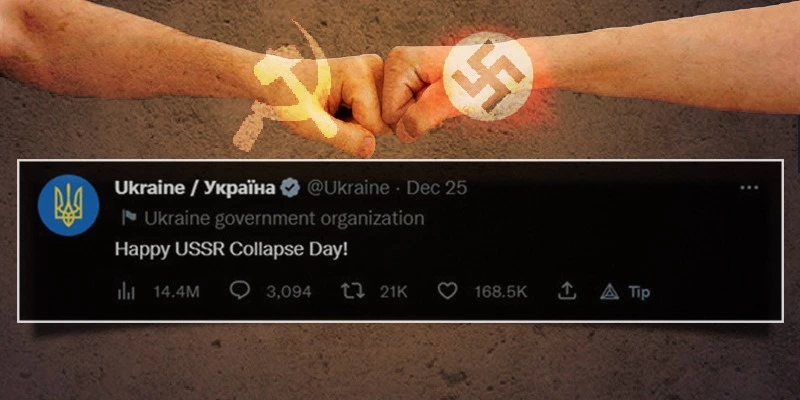
On 25th December 2022, the official Twitter account of the Government of Ukraine posted celebrating the collapse of the USSR. During a meeting in the Ukrainian parliament on June 16th, the Education and Science Ministry announced the removal of more than forty works by Soviet and Russian authors – including stalwarts like Alexander Pushkin, Anton Chekhov, Mikhail Bulgakov, Ivan Turgenev, Fyodor Dostoevsky, Alexander Blok, Anna Akhmatova, Vladimir Mayakovsky, Boris Pasternak, Leo Tolstoy, Sergey Yesenin – from school textbooks. The regime is trying hard to get rid of the shadow of the Soviet past.
A myth about the USSR is that it was a Russian imperialist state, with Marxism-Leninism just a tool of subjugation. But history shows otherwise. Kiev was the first capital of any Russian state in the 9th century. The Russian SSR, Ukrainian SSR and the Belorussian SSR were the founding members of the Soviet Union. Leon Trotsky, a founder of the Bolshevik state and founder of the Red Army, was from Kherson, currently the focal point of battles between Russia and Ukraine, the latter being supported by NATO. Nikita Khrushchev, the Soviet Premier from 1953 to 1964, was raised in Donbas, and helped to transfer Crimea to Ukrainian administration. Leonid Brezhnev, Premier 1964-1982, was from central Ukraine – some even believe him to have been of Ukrainian ethnicity. And Stalin, the leader most criticised for “Russifying” the Union, was from Georgia.
The Soviet state had an intentional policy of intermingling ethnicities and languages – and that policy was implemented to such an extent that the USSR declined to sign the Geneva Convention at first, citing Articles 9 and 10 which included a clause stating: "Belligerents shall, so far as possible, avoid assembling in a single camp prisoners of different races or nationalities" – a clause which was against the basic moral foundations of the Soviet Union. For this very reason, ethnic Ukrainians comprise around 10% of the population as far afield as Eastern Siberia.

Source: Kyiv International Institute of Sociology
In a poll conducted by the Kyiv International Institute of Sociology in 2020, six years after the Russian annexation of Crimea, the majority of the respondents aged 60 and above regretted the dissolution of the former USSR. A secure job, income, pension, housing and healthcare are all they wish for. Among those below the age of 60, including the post-Soviet generation, most do not regret the dissolution of the Union. Those born after the 1960s, who grew up during the economic stagnation period, naturally feel differently than those born earlier. Those still living from the generation who experienced the Great Patriotic War (World War II and specifically the Eastern Front) remain very concerned about the state of affairs under post-socialist governments.
Source: Kyiv International Institute of Sociology
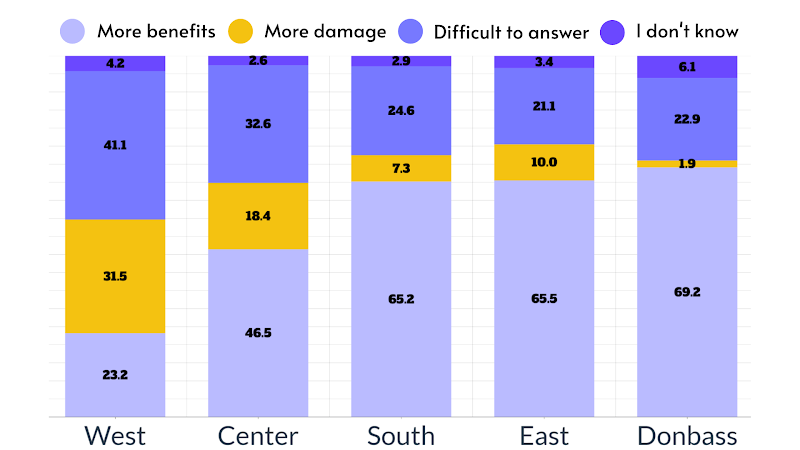
What is even more interesting is another poll that was conducted back in 2013, one year before the Crimean annexation. The question was “In general, in your opinion, did membership of the Soviet Union bring Ukraine more benefits or more harm?” – 23.2% in the West, 46.5% in the Central region, 65.2% in the South, 65.5% in the East, and 69.2% in the Donbas region said ‘more benefits'.
These findings clearly indicate that the current sentiment has more to do with the antagonism between the Ukraine and the present Russian state than the real experience of the people of the former USSR.
Within three years of the dissolution of the Union, Ukraine’s economy shrank by 20%. The decade experienced rampant corruption and an oligarchy taking over, somewhat similar to what happened in Russia at the time. Things turned murkier with the “Orange revolution” and Viktor Yushchenko’s installation as President. To pursue greater ties with the West, Yushchenko distanced himself from Russia. And the most shocking event happened in 2010, as he awarded the title “Hero of Ukraine” to Stepan Bandera, the most notorious Nazi collaborator during World War II, who pledged allegiance to Hitler and who after the war worked for British and American intelligence. Although a subsequent court decision annulled the award, it set in motion a chain of forces that continue to plague Ukrainian society today, giving momentum to neo-Nazi organizations, battalions and ideologues which started going mainstream.
The 2014 election saw the removal of the pro-Russian president Viktor Yanukovych in a coup-like fashion after he postponed the signing of an agreement for more integration of Ukraine with the EU. There were protests by pro-EU as well as pro-Russian protesters throughout the country. During one such event in Odessa, some pro-Russian protesters – outnumbered by their pro-EU counterparts – retreated to the Trade Unions House. A fire broke out there which killed 46 pro-Russian protesters, and it's easy to deduce who was behind it. This event led to a complete polarization within the Ukrainian populace, between East and West, triggering a fully armed separatist movement in Donbas and neighbouring regions.
Ukraine lies at the crossroads of civilization between East and West. By surgically cutting it off from its inseparable Eastern identity and forcing it to become part of the “West”, Ukraine’s soul will be extinguished. Serving as a proxy of the US and NATO might prove fatal for its economy and its security as well as for its entire historical Slavic identity. The whole of Eastern Europe suffered from Fascist butchers, and the new generations must be made aware of that history and must stop sabotaging their countries in the name of so-called de-Russification and decommunization.
If you are a socialist, We need you now!✕
We are proudly biased towards Anti Capitalist, Anti Imperialist, Anti fascist! We believe we don’t need to mention you the importance of marxist magazine in this era! We are depending on our comrades only! Make an investment of $2.5/m in making a quality journal inclined to Marxism Leninism! Your one potential subscription helps us to maintain our global team! Subscribe and get access of all exclusive content available at the magazine section!