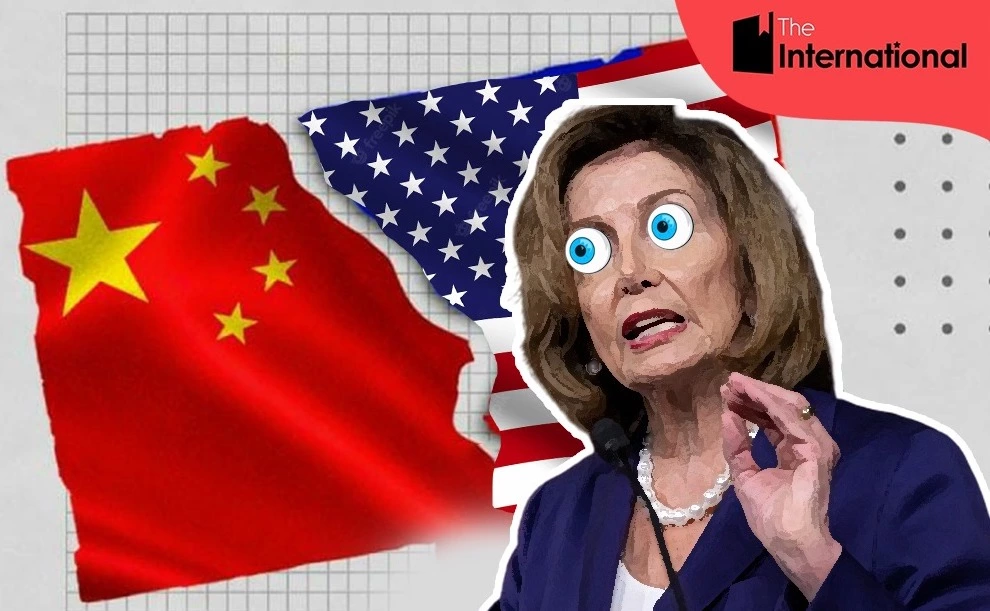
A visit by U.S. House Speaker Nancy Pelosi to China’s Taiwan, today, Tuesday, August 2, has sparked vigorous warnings on the part of Chinese officials, according to an August 1 statement by Chinese Foreign Ministry spokesperson Zhao Lijian as reported on the Venezuelan TV network Telesur. The network’s English-language website quotes the Chinese spokesperson as warning that "The will of the people cannot be defied, and those who play with fire will perish by it... It is believed the U.S. side is fully aware of China's stand- clear message… A visit to Taiwan by [Pelosi] would constitute a gross interference in China's internal affairs, seriously undermine China's sovereignty and territorial integrity, wantonly trample on the one-China principle, greatly threaten peace and stability across the Taiwan Strait, severely undermine China-U.S. relations, and lead to a very serious situation and grave consequences."
The standoff between the People’s Republic of China (PRC) and US-backed separatists on Taiwan dates all the way back to the very foundation of the PRC in October, 1949, when the Kuomintang (KMT) Nationalist Chinese government of the time fled with its few remaining forces to China’s island province of Taiwan. Over the intervening decades, tensions over Taiwan have occasionally neared a boiling point, particularly in the era before Richard Nixon’s recognition in 1972 of the People’s Republic of China as the only legitimate government of China, and Taiwan as a breakaway province of China.
According to Wikipedia:
The phrase "Quemoy and Matsu" became part of American political language in the 1960 U.S. presidential election. During the debates, both candidates, Vice-President Richard Nixon and Senator John F. Kennedy, pledged to use American forces if necessary to protect Taiwan from invasion by the PRC, which the United States did not recognize as the legitimate government of China. However, in the second debate on 7 October 1960, the two candidates stated different opinions about whether American forces should also be used to protect Taiwan's forward positions, Quemoy and Matsu. Senator Kennedy stated that these islands—as little as 9 kilometres (5.5 mi) off the coast of China and as much as 170 kilometres (106 mi) from Taiwan—were strategically indefensible and were not essential to the defense of Taiwan.
…
In 1979, the Taiwan Relations Act was signed by President Carter, which committed the United States to provide military and other support for Taiwan and provided guidelines for future trade and other relations.
Today, the question of Taiwan has once again become thorny, as Chinese officials’ patience with over 70 years of anomalous control over the island seems to be once again wearing thin. China has offered multiple peaceful routes for resolution of the situation, including the establishment of a “one country, two systems” solution similar to that currently existing in China’s Hong Kong and Macau, but up to now without success. Paradoxically, China’s relations with the authorities in Taiwan have often seemed best when Taiwanese voters elected traditional parties who are traditionally most opposed to the People’s Republic and who continue to vainly claim to be the rightful government of the entire country of China, successors of the KMT (Nationalist) government that fled the mainland in 1949, as opposed to parties and candidates who claim to recognize the PRC as legitimate but seek Taiwan’s independence.
Today, the Chinese news agency Xinhua reports from Dushanbe, capital of the post-Soviet republic of Tajikistan, that Chinese State Councilor and Foreign Minister Wang Yi “stressed that the one-China principle is the consensus of the international community, the political foundation of China's exchanges with other countries, the center of China's core interests, and the red line and bottom line that cannot be crossed.”
According to Xinhua, Wang noted that “Some in the United States are constantly challenging China's sovereignty on the Taiwan question, hollowing out the one-China policy and even deliberately stirring up troubles in the Taiwan Strait.” The Chinese official told reporters, “The Chinese people will never accept this and the international community also scorns such groundless provocation.” According to Xinhua, Wang stressed that the one-China principle is the consensus of the international community, the political foundation of China's exchanges with other countries, the center of China's core interests, and the red line and bottom line that cannot be crossed.
Evidently making oblique reference to Pelosi’s visit to Taiwan, the Xinhua report shared a blunt warning: “Some U.S. politicians only care about their self-interests, blatantly play with fire on the Taiwan question, make themselves enemies of the 1.4 billion Chinese people, and will definitely end up in no good place, he warned. The bullying deeds of Washington have been exposed to the world and made people of all countries see more clearly that the United States is the biggest destroyer of peace today, Wang added.”
According to headlines in the New York Times, Pelosi landed in Taipei, the island’s capital today at some time after Noon, Washington time, and was met on the tarmac by local authorities. As of this writing it is not yet clear what if any concrete steps will be taken by Chinese officials to respond to what the PRC sees as a gross provocation. Yet, even in the United States Pelosi’s action has not drawn universal support. As an example, New York Times editorial writer Thomas L. Friedman warns that “Pelosi’s visit to Taiwan is Utterly Reckless.”
As this report is being written, Xinhua has just released the following bulletin: “BEIJING, Aug. 2 (Xinhua) -- Xinhua News Agency is authorized on Tuesday to release the following notice: from 1200 (Beijing Time) August 4 to 1200 (Beijing Time) August 7, 2022, the Chinese People's Liberation Army will conduct important military exercises and training activities including live-fire drills in the following maritime areas and their air space…” including coordinates for six non-contiguous zones surrounding the island of Taiwan. The bulletin warns, “For safety reasons, entering of vessels and aircraft to the above-mentioned sea and air space is prohibited.”
It is not clear how or whether Pelosi’s departure from the island will be affected by this development.