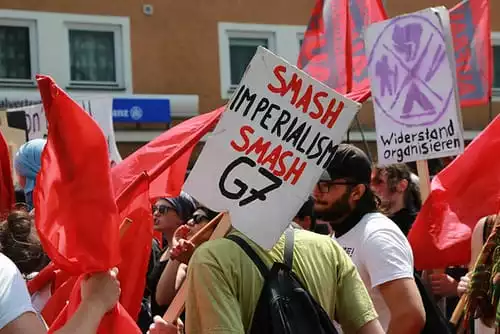
Fears of conflict over Taiwan dominated the recent G7 Foreign Ministers’ meeting in Sapporo, but are they really justified?
China couldn’t make it more clear that it wants a reunification with Taiwan, many in Taiwan agree and many want to maintain the status quo. For most of the last 70 years, including today, China accepts this. The view in China is that reunification is inevitable, not because the CPC want it but because the Chinese people want it. And, if we’re honest, that’s called democracy. The problem is that much of the “international community” is not honest about what they want, or at least the international community as led by the USA. So, let’s be honest about the USA’s leadership for a moment. They control NATO, they control the United Nations, they control the G7 and they make rules to suit themselves. Constantly calling on others to “comply with international law” whilst at the same time, according to the UN, disregarding their own nation’s human rights while violating those of other nationals.
They refuse to ratify the UN Convention on the Law of the Sea but constantly invoke it when critical of China in the South China Sea. They have not only refused to comply with the International Criminal Court but have written their own law to protect American war criminals. That law allows them to both sanction any International Criminal Court investigators who look into US war crimes and even invade the Hague, a part of a sovereign nation, the Netherlands, if an American is arrested by the ICC. Despite that, they support the ICC in any investigations related to Russia, including the recent warrant to arrest Putin and have never called for any investigations into Ukraine.
Double standards and a “Rules Based Order” are prevalent wherever the US meets. Their recent G7 Foreign Minister’s meeting in Japan was no exception. Blinken made an appearance direct from Vietnam. Western media promoted the strength of that relationship and raised fears over some imaginary alarm Vietnam has about China’s growing military. No evidence was given to support this fear and no mention was made of the recent state visit by President Nguyen to China where a joint statement on strengthening and deepening the cooperation between the two countries was signed. Biden’s phone call to Nguyen last month and now Blinken’s trip were seemingly both designed to undermine that.

The G7 needs to be taken into context for what it is: a political body which does not, as many people believe, represent the top 7 global economies, if it did, Italy and Canada would be moved out so that India and China could move in. India is perhaps the loser here, the only reason why the world’s most populous democracy, and number 5 on the list of top economies is not there, is because they are too poor to be of benefit. China is different, it has an ideology that the USA doesn’t agree with so it will be excluded at all costs.
This group of 7 governments represents about 10% of the global population and 27% of the world’s GDP. Let that sink in for a moment, seven governments that represent 0.8 billion people control more than quarter of the world’s GDP. France, Germany, Italy, Japan and the UK were all colonial expansionists and enriched themselves by exploitation of their colonies. USA and Canada are settler colonialists, each with a history of genocide. Judge for yourself if these are the kinds of governments that care for world peace or betterment of mankind.


The G7 was set up i nitially in 1975 with a view to leading the world through an economic crisis but has changed its course and is now a strategic planner of future developments. Unfortunately, their agreements do not benefit the developing world.
In 2021, under Biden’s leadership, the G7 agreed to historic tax reforms. The principle was that a global tax of 15% would be applied on all businesses and the ability to “offshore” companies to avoid taxes would be eliminated. Two years later, this is still years away from implementation, and, if implemented, developing nations would not benefit.
In that same year, the B3W initiative was launched, not to benefit the world but to offset challenges from China and provide an alternative to China’s BRI. It would be nice if China’s strategies in the underdeveloped world had spurred rich leaders to help mankind but it did not.
B3W it has achieved nothing. What was announced a year after its launch turned out to be nothing more than a number of ongoing projects which were moved under the umbrella of B3W as I reported in Pearls and Irritations here.
This Foreign Ministers meeting in Sapporo did not benefit the global south. It was a meeting to benefit the 10% they represent and for the US to consolidate its waning over the Indo-Pacific and to safeguard greater compliance and cohesion from other members.
It's clear that, no matter what this meeting claims about unity, there are rifts. The usual platitudes about climate and energy were overshadowed by the release of “treated water”, a euphemism for nuclear waste water, into the ocean by Japan. Japan also claims to be very concerned about potential conflict over Taiwan and the US claims it wants nothing other than the status quo to be maintained.
However, the status quo isn’t exemplified by increasing arms sales, making visits by senior politicians, putting “training” troops on the ground. If the status quo were returned to previous levels of a few years ago, there would be no need for talk of conflict. China has made it clear that conflict will be seen as a strategic failure and only necessary to prevent Chinese property being taken away by western influence… again!
President Macron of France, controversially stating the quiet part out loud, after his visit to China suggested it would be wise not to be drawn into a conflict and Europe should reduce its reliance on the USA. He’s perhaps the first, and in recent years only member of the G7 to voice dissent since Charles De Gaulle upset NATO in 1963.
Germany, currently embroiled in its own problems has many companies investing heavily in China and Italy has signed an MoU with BRI, the only one of the G7 and one of the few industrialised nations to have done so.
In fact, about the only thing G7 members can agree on is an unreasonable and unwarranted fear from a rising China.
Editor's Note:
The views and informations expressed in the article are solely those of the author and may or may not reflect the views of The International. We believe in providing a platform for a range of viewpoints from the left.