On December 19, we will commemorate the 3rd anniversary of the Sudanese uprising. This popular movement of unprecedented magnitude put an end to the obscurantist and anti-democratic regime of President Omar al-Bashir. As the country prepares to celebrate this date, the October 25 coup d'état has reminded everyone that the road to the revolution's triumph will be long and fraught with obstacles.
The December 19 uprising
Sudan has experienced military governments for over 50 years. Gaafar Mohammed an-Nimeiry inaugurated this era in 1969. He was in turn deposed in 1985 by Al-Jazuli Daf'allah, who established a civilian regime that short-lived. Indeed, in 1989, a new putsch brought to power Omar Hassan Ahmad al-Bashir who remained in power until the triumph of the December 19, 2018, uprising.
Events in recent years in Sudan are prescient. The Sudanese uprising will herald a series of popular movements in the Arab world whose demands are much the same. From the streets of Khartoum to Beirut and Baghdad, social justice is at the heart of the claims made during the demonstrations. The Sudanese people have taken to the streets to denounce, among other things, the rising cost of basic commodities, austerity measures, the end of subsidies for basic necessities, the devaluation of the currency and rampant inflation.
From the outset, the Sudanese uprising was organized around coalitions of opposition forces as diverse as they were varied. Notably, in addition to the opposition political parties, a coalition of trade unions, the Sudanese Professional Association, led the frontal opposition to the Omar al-Bashir regime. This union presence distinguishes the Sudanese uprising from similar movements in Iraq and Lebanon. Popular unrest, at the cost of hundreds of deaths and thousands of injuries, brought an end to the regime of Omar al-Bashir in April 2019. A transitional government combining civilians and the military was set up. The military presence in this government is a way for the former regime to minimize the gains of the uprising. Last September, Elfadil Elhashmi, a member of the Sudanese Communist Party, explained to the Canadian newspaper People's Voice the nature of this transitional government: « It is an unfinished process in which the political ruling strata have been defeated but the old system, the deep security and militia State and economically deeply rooted system is still hanging on to its resources. The Old is half alive, and the New has yet to emerge from the womb of the Old. »

Communists at the forefront
Since the events of December 2018, the Sudanese Communist Party has returned to the forefront after 50 years of bloody repression. Recall that this led to the execution of prominent party members including the former secretary general, Abdel Khaliq Mahjub, in 1971. The Party is at the core of the political and trade union struggle and, more generally, of the struggle for a successful transition from military rule. Its positions in favor of an interlude that takes into consideration the socio-economic concerns of the population, the main cause of the uprising, distinguishes it from the main opposition parties and organizations. Indeed, after the triumph of April 2019 and the fall of Omar al-Bashir's regime, the party opposed negotiations with the military. These talks, which led to the establishment of a coalition government between civilians and the military, led to the implementation of austerity plans by the World Bank and the International Monetary Fund. In short, the Party is opposed to a simple transfer of power that would not lead to structural change.
Thus, the Party puts forward the need to establish a civilian transitional government. In reality, the Sudanese army is the trojan horse of imperialism. This institution survives on US funding. It has been involved for years in the murderous war and occupation of Yemen at the behest of the reactionary regimes of the Persian Gulf. It is also the Sudanese section that is most in favor of normalizing relations with Israel, against the majority opinion of the population. It should be remembered that this normalization was imposed by the United States a year ago in the wake of the Abraham Accords.

The uprising in light of the October 25 coup
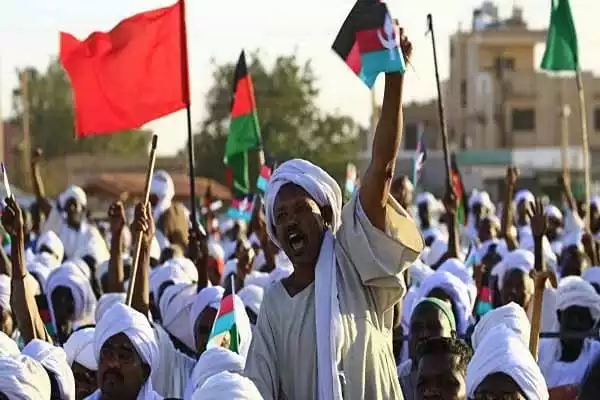
On October 25, 2021, taking advantage of disillusionment with the transitional government, the military, led by its commander in chief, General Abdel Fattah al-Burhan, took over full power and detained the civilian component of the government. This move is widely perceived by the Sudanese population as a step backwards and therefore, as an impediment to the revolutionary process underway since December 19, 2018. As a result, the reaction of the Sudanese people was immediate and unequivocal: hundreds of thousands of protesters took to the streets to reject the military option and demand the establishment of a civilian government that will implement the long-awaited socio-economic and structural political reforms and this, in the wake of the demands of the December 19, 2018, uprising.
The large popular mobilization of October 30 halted the new military power's momentum. Under pressure from the street, the coup leaders seem to be backing down on its initial positions and releasing civilian ministers arrested in the wake of the coup. Thus, it is the strength and determination of the uprising that will shape the nature of the next government. This is a key moment in the contemporary history of Sudan. Therefore, international solidarity with the Sudanese people uprising and with the Sudanese Communist Party which is promoting a civilian government is essential.