The moon waxes and wanes, the tide ebbs and flows, empires come and go, but some empires come more than once. This is, once again, China’s time. While there have been moves to prevent this from occurring, one recent event proves they are unsuccessful.
In August 2022, Biden signed Executive Order 14080 ostensibly aimed at boosting USA’s domestic semiconductor industry. But it was nothing of the sort; rather it was aimed at stopping China from developing. Just a month later, Executive Order 14083 was designed to prevent China from obtaining the technology which could be used in military applications but is also used in smartphones, smart cars, and pretty much everything else that might be considered “smart”.
These executive orders along with other bills passing through US Congress are not designed to protect and help US industry; they are, by the admission of the White House, designed to slow down China.
However, it isn’t working. China is emerging as the global leader in economy, with a Price Purchasing Parity which overtook USA several years ago; a nominal GDP which is growing faster and stronger than the USA and could land China in the No. 1 slot as early as 2028. China is also way ahead in agricultural and manufacturing output while the US is, by far, ahead on services.
A tweet from last October made it clear that at least some tech experts and China watchers were confident, as a result of these Executive Orders and Congressional Bills, that the Chinese tech industry was finished. The tweet’s thread gathered over 81,500 “likes” and almost 27,000 reposts. Those that were commentating were very much in agreement: China was done!
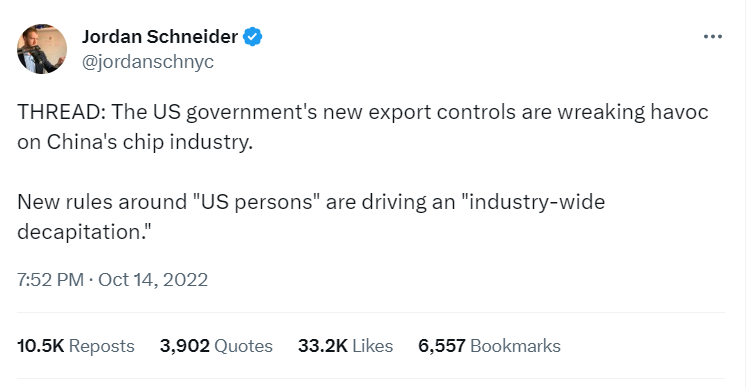
While pro-China accounts pronounced it would make China stronger, there were some interesting takes from people who obviously have no love for China, questioning the possibility of something that most people who know China well, knew would happen; a not-too-distant-future event that, to many at the time, seemed unlikely: China would emerge stronger.
Less than one year later, that moment arrived. Huawei, a company that has been targeted with sanction after sanction, without much fanfare, delivered the fully “made in China” Mate 60 Pro Mobile Phone. In doing so they achieved several goals: they proved the tech world wrong; they produced a sell-out phone; they have regained their place among the top brands in mobile phones globally after losing it due to US sanctions; and gave a much-needed boost to Chinese pride.
The timing of the release was hardly a coincidence, US Commerce Secretary Gina Raimondo was in Beijing and would undoubtedly have been made aware of her department’s failure to contain China and in particular, Huawei.
Without getting too technical, the phone is a 5G smartphone using Huawei’s own Harmony 4.0 operating system. People in the West have become used to a choice of iOS and Android, people in China have a third option, the Harmony system which has the ability to access another Huawei innovation, the PanGu Artificial Intelligence system. And, as an additional extra, it can make satellite calls for only 8RMB per minute (about US$1.20).
What fully “made in China” represents to the people of China is hugely important: 10,000 parts, all domestically made including the 7nm, Kirin 9000 Chip. This is as important a moment in Chinese history as the Macartney Embassy to China of 1792/93. That mission showcased all that was good from the British Industrial Revolution but was rejected by the Qianglong Emperor. In retrospect, a poor decision by China because that rejection ultimately created the conditions leading to the Opium Wars and China’s “Century of Humiliation”.
Huawei’s success in creating a mobile phone is seen as the moment China reversed this. In 2019, Trump signed an Executive Order which banned Huawei from using Android. That should have effectively destroyed Huawei’s mobile phone business, but it didn’t.
Huawei came back with its own Harmony operating system. Then, under Biden, suppliers of chips globally were forbidden to sell to Huawei, so, China’s SMIC manufactured its own. Huawei put them into the Mate 60 Pro and launched it. It sold out, within an hour in the stores and minutes online all 800,000 made, were sold. Huawei had more good news to announce, the same week they had shipped 100 million cumulative phones.
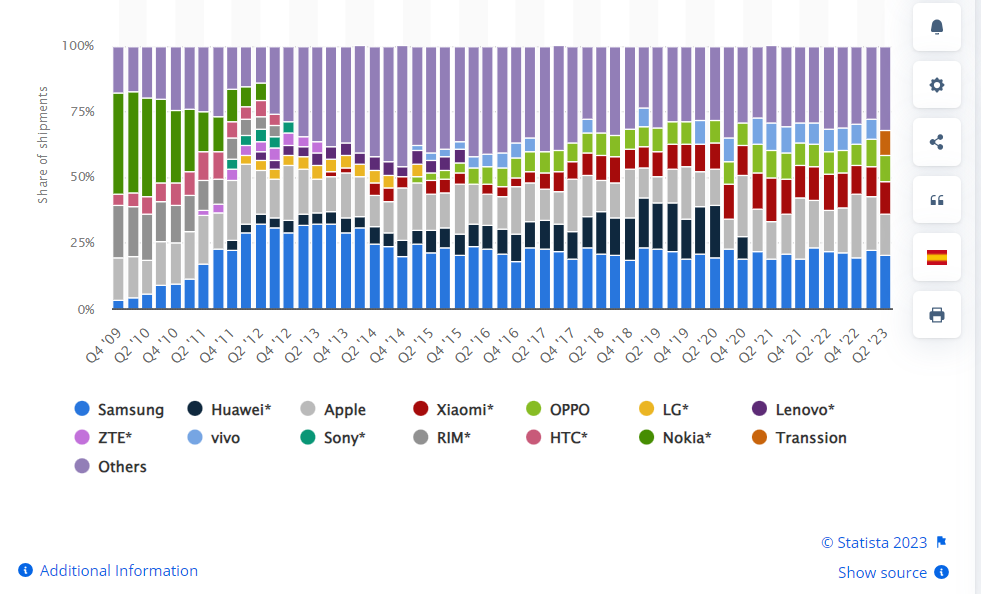
Huawei entered the smartphone market in Q4 2011 and captured 3.5% of total sales; in Q2 of 2020 the brand overtook Samsung to be the world’s most popular phone but then the US stepped in with sanctions. So, after capturing 20% of the entire smartphone market in that quarter, they were out of the running completely by Q1 2022. For many companies that would have been the end of the road. But Huawei is not like many other companies; it’s a very different and very resilient organisation.
Huawei employees are the owners of the company, that in itself, while unusual, is not unique. Some of the rules in “Huawei’s Basic Law” are interesting. An employee may retire at 45 years of age if they have worked for the company for 8 years and they may keep their shares. If they want to leave and go to another company, they return their shares. And, according to academic reports from inside the organisation, they attract the best, retain the best, and many employees consider themselves to work as hard as top level athletes in order to remain the best.
This isn’t just a success story for Huawei, but a huge success for China. When excluded from the Space Station by the Wolf Amendment, which even US think tanks decry as a poor decision, China built their own. When threatened by the world’s largest and most expensive military, China built a bigger, defensive military. When a stellar product of China is denied business opportunities on the global stage, China creates the environment whereby it can still outperform both internationally and domestically.
A search on UK’s BBC, USA’s CNN and Fox News, as well as Australia’s ABC, reveal nothing of the Huawei Mate 60 Pro. It’s almost like, outside of China it never happened, or perhaps it happened but media don’t want the world to know about it. Because this isn’t a commercial success; this is evidence, the empire can, and will, strike back.
Editor's Note:
The views and informations expressed in the article are solely those of the author and may or may not reflect the views of The International. We believe in providing a platform for a range of viewpoints from the left.
"The International" belongs to you.✕
Please take a moment to read this. We apologize for any interruption, we want you to know "The International" seeks your valued support at this time. We've proudly served as a pioneering online platform, delivering ad-free media content. With only 2% of our readers opting for a subscription, any contribution you choose holds immense significance—whether it's an annual fee of $25 or a monthly payment of $2.5. — The "The International" Team, committed to providing you with enlightening perspectives. We want to highlight that this sum is even less than what you'd spend on a cup of coffee, yet it greatly aids in sustaining our efforts to perpetuate and enhance your esteemed initiative.