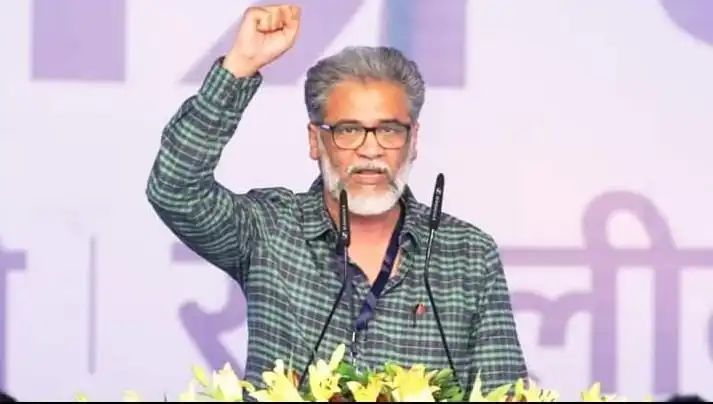
On behalf of The International, Akash Chatterjee interviewed Comrade Dipankar Bhattacharyya, General Secretary of Communist Party of India (Marxist-Leninist) Liberation or CPI(ML) Lib in short. CPI(ML) Lib is one of the major mainstream communist parties of India and they have won two seats in the Indian parliament this time. Since its formation, they are sending their representatives to the Indian parliament for the first time. Comrade Dipankar Bhattacharyya is now one of the key faces of Indian left movement.
Let's have a look at what Comrade Dipankar said to The International.
Q1. In a state like Bihar, where caste always plays a predominant role in every election with the RJD drawing support from the Yadavs and the JD(U) drawing support from the Kurmis, how is CPI(ML) Liberation consolidating its mass base? Does CPI(ML) Liberation also follow the same pattern of consolidating people based on caste lines? If yes, can you tell us a bit about the class-caste equations at play that may catapult your party to national significance?
Ans. We do not mobilise people on caste lines, but caste and class being intimately intertwined, class politics constantly has to navigate the caste question. We have always seen class struggle as a struggle against the dominant power (local and immediate as well as national and global). In Bihar our struggle has grown by challenging and denting the feudal power and this feudal power uses the caste order to the hilt. The landless agricultural labourers and the poor and marginal peasants who form our main base in rural Bihar are predominantly from Dalit and other oppressed caste background, and from our inception we have always fought against caste oppression and feudal violence and domination.
Q2. The enthusiasts in Bihar politics are aware of how the CPI(ML) Liberation consolidated the Dalits after the Laxmanpur Bathe massacre. For our readers, can you tell a bit about how the Liberation consolidated Dalits in those areas and put up a staunch fight against the Ranveer Sena during the ‘80s?
Ans. It is not that we consolidated our Dalit base in the wake of the massacres perpetrated by the Ranveer Sena in the late 1990s and early 2000s. The spark of the Naxalbari peasant uprising in the late 1960s had lit a prairie fire in large parts of feudal-dominated Bihar and CPI(ML) emerged as a revolutionary communist party fighting for the rights and dignity of the oppressed poor.


Feudal reaction and violence took a virulent form of private army after we started participating in elections. In 1989 when we first fought in a parliamentary election and landless labourers and oppressed Dalits managed not only to exercise their franchise for the first time but also elect their leader as the victorious member of parliament, we had to suffer a violent feudal backlash. Right after the polling, twenty-odd people were massacred by upper caste-backed armed goons. The Ranveer Sena rose in the mid 1990s after our victory in Bihar Assembly election from some of our key areas of anti-feudal struggle. The massacres perpetrated by the Sena in Bihar bore all the hallmarks of fascist communal violence that we soon saw in Gujarat.
As feudal reaction dovetailed into the larger project of fascist aggression, anti-fascist resistance evolved as a progression of anti-feudal struggle in Bihar. The oppressed poor have always had to fight for basic democracy and dignity. The same battle has now emerged as the common plank for the broad spectrum of anti-fascist resistance.

Q3. Along with caste, we saw in the last Bihar assembly election that unemployment and inflation became two big issues. Your party played a role in this change in narratives. How did CPI(ML) Liberation make it possible to change the dynamics of Bihar politics?
Ans. Acute poverty, unemployment, out-migration of labour remain major issues of Bihar. We are glad that the question of jobs, poverty alleviation and economic justice has begun to gain greater importance not just in Bihar, but as the 2024 elections showed, across the country. The farmers' movement against corporate takeover of agriculture is another recent development that has also facilitated a shift in the agenda everywhere. Finally, Read the whole Interview
Editor's Note:
The views and informations expressed in the article are solely those of the author and may or may not reflect the views of The International. We believe in providing a platform for a range of viewpoints from the left.
"The International" belongs to you.✕
Please take a moment to read this. We apologize for any interruption, we want you to know "The International" seeks your valued support at this time. We've proudly served as a pioneering online platform, delivering ad-free media content. With only 2% of our readers opting for a subscription, any contribution you choose holds immense significance—whether it's an annual fee of $25 or a monthly payment of $2.5. — The "The International" Team, committed to providing you with enlightening perspectives. We want to highlight that this sum is even less than what you'd spend on a cup of coffee, yet it greatly aids in sustaining our efforts to perpetuate and enhance your esteemed initiative.