I am writing this on the heels of the paper written by two highly respected German sinologists, Thomas Herberer, a professor of Chinese Politics at Duisburg-Essen University, and Helwig Schmidt-Glintzer, a professor of Chinese studies and director of China Centrum Tubingen.
A crucial point of the article acknowledges the existence of "massive Islamic terrorism" in Xinjiang between the years 2010 and 2016 at the hands of twelve separatist-Islamist movements operating there. Even the US acknowledged the existence of terrorist groups in Xinjiang and its bordering countries at the time, even though today we see Washington DC-based NGOs insisting this was not the case. Be reminded that former Secretary of State Pompeo, under the Trump administration, as one of his last acts as Secretary, decided to remove one of these groups from the CIA's terrorist list.
The fact is that the region was on the brink of chaos, and it was necessary for the central government to take swift action.
Unlike America's war on terror, characterized by US troops invading the wrong countries, destroying infrastructure, pillaging resources, terrorizing locals and conducting drone strikes that killed civilians and journalists, as Julian Assange valiantly exposed on WikiLeaks, China's approach to counter terrorist forces was different.
Safety
Perhaps the most pressing measure was reestablishing safety. This entailed the deployment of a military and security presence, the implementation of tighter border security, and the gathering of intelligence, which included every member of society - even members of law enforcement were found to be double agents and religious institutions, given that Islamist radicals were disseminating hate-inspired messages from their pulpits.
Over these years, Western governments, politicians, and pundits have qualified the measures by the central government as excessive, targeted at both Uyghurs and Islam. While there is a discussion to be had regarding what is considered excessive or systemic in the midst of China's domestic "war on terror," the rest of the statement must be rectified.
Measures by the central government focused on dismantling terrorist networks - networks that were, without a doubt, comprised largely of Uyghur and Muslims living in Xinjiang and abroad.
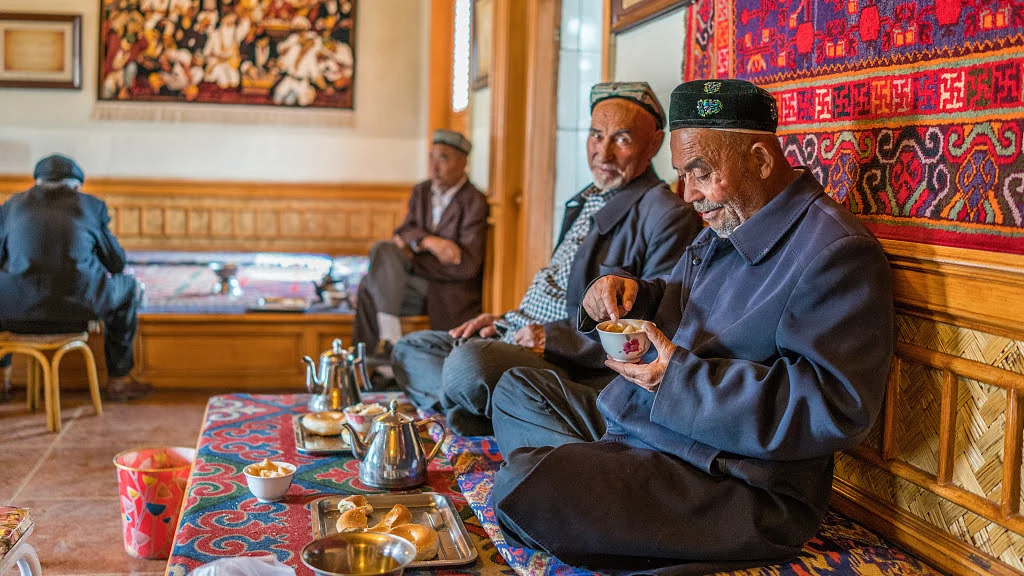
It is important to recognize two facts: in Xinjiang, not all Uyghurs are Muslim, and not all Muslims are Uyghur.
The latest census puts the Uyghur population in Xinjiang at 12 million while there are an estimated 15 million Muslims. Many members of the 40 other minorities in Xinjiang practice Islam, such as the Hui, Kazakh, and Kyrgyz, to name a few.
The second is that these terrorist groups targeted not only Han Chinese but also moderate Muslim citizens.
Perhaps the turning point of the fight against terror in Xinjiang was the heinous assassination of Imam Juma Tahir in Kashgar in July of 2014. His death at the hands of three extremists became a wake-up call to all people in Xinjiang. Those who, up to then, may have been reticent to implement measures, suddenly became more accepting of them.
It was clear no one was safe from these extremists, and something needed to be done in order to capture and dismantle these organizations.
Maybe this prompted the adoption of the pomegranate as a symbol of unity amongst the Xinjiang people. This abundant local fruit can be seen displayed on billboards, murals, sculptures, and more throughout Xinjiang. It serves as a reminder of the importance of sticking together as Chinese citizens, just like the seeds of the pomegranate.
Poverty
Most experts agree that radicalization and separatism flourish among a population characterized by poverty and dissatisfaction with the government.
For centuries, and despite the harsh nature of Xinjiang's weather and terrain, the region was an important part of the Silk Road. Most of its largest cities were prosperous hubs for trade and commerce, as well as centers for the exchange of ideas, traditions, and knowledge.
However, as modernity and globalization favored maritime commercial routes, Xinjiang's prosperity and development were negatively impacted. It is important to explore how this issue was tackled, and acknowledge it was not a government imposition on the region.
Over the past 20 years, while neighboring countries were struggling with the aftermath of America's war on terror and the resulting poverty, China allocated unimaginable resources to develop logistics, transportation infrastructure, and means of production in Xinjiang.
Although China’s Poverty Alleviation is the greatest humanitarian campaign in history, its implementation in Xinjiang faced unique challenges such as the region's size, the roughness of its terrain, inclement weather, and a scattered population living in remote rural areas.

One of the primary objectives was to connect cities and prefectures with roads, highways, railroads, and the internet. Additionally, the aim was to attract investment and businesses to the region to increase household income levels by providing alternative sources of sustenance beyond agriculture and herding.
The task required improving people’s employability by means of better education and vocational skills training; these often involved the mobilization of students and skilled laborers to areas where services were offered and where their talents were needed since the region is characterized by low population density and scattered rural communities.
Under these circumstances, the most cost-effective way to deliver on the objectives is through institutions that offer room and board.
Satellite imagery of many of these educational and production facilities, as well as some correctional institutions, was mislabeled as “concentration camps” by foreign think tanks. Suffice to say, anyone visiting production or education facilities anywhere in China can confirm the use of dormitories and mobilization of talent are key to China’s economic miracle, starting with the Reform and Opening-up in 1979.
Western governments, politicians, pundits, and US-funded NGOs have inaccurately yet persistently portrayed the above China development strategy as evidence of human rights abuses, forced labor, and separation of families. It is crucial to remember that variations of this approach are followed in most countries around the world; people move to find better education and employment opportunities.
With regard to individuals who showed signs of early indoctrination or incipient separatist ideologies, patriotic education and vocational skills were offered in lieu of punishment; the government believed it necessary to provide non-punitive options and instead, incorporate them into regular Poverty Alleviation programs.
Lastly, there were also terrorists, their mentors, financiers, aiders, and abettors who were caught and imprisoned. It is revealing to see NGOs, pundits, and criminals on the run, regularly call for the release of these criminals on social media.
Surveillance
Xinjiang's location, size, and topography make it challenging to control its long borders with eight countries, some of which have been hotbeds for terrorism for decades. Individuals indoctrinated and trained by terrorist organizations abroad used to come into the region with relative ease and hide in rural areas. To address the issue, police stations were set up in every village, town, and city, as well as checkpoints along every road connecting them. Even today, every streetlight has a unique number to identify it.
This system allows residents to accurately inform authorities the location of any security incident. To help with police response time, cameras were installed at every corner, intersection, point of entry, and place of interest.
Even so, it is mostly a reactive system. Its effectiveness is highest when residents initiate an operation after having called the police.
Biometrics and Facial Recognition
Biometrics and face detection technology played a pivotal role in introducing effective passive surveillance. Once facial features of residents and visitors are registered onto the database, these systems can preemptively alert authorities of the presence of non-registered individuals and intelligently begin tracking their whereabouts.
The companies responsible for developing these breakthroughs in passive surveillance are criticized and even sanctioned by governments, entities, and individuals who are committed to prevent a peaceful, harmonious, and prosperous society in Xinjiang.
To expand on a point recounted in the article published by the two German researchers, these companies are directly responsible for the marked decrease in the number of police deployed, security checks, and road checkpoints reported. They have also sped up the security checks, which now can be done in seconds by simply swiping an ID card and matching it to the database using facial detection. Drivers and passengers do not have to get off the vehicle; rolling down windows is enough.
As my five-month, 15,000-kilometer self-driving tour of Xinjiang ends this August, and having visited more than 40 locations in every corner of the Autonomous Region, I can confirm the changes mentioned above, compared to my experience traveling in the region 3 years ago.
It has been nearly seven years since the last terrorist attack in Xinjiang in 2017. While central government's implementation of these strict security measures was initially met with reticence by some, it is undeniable that currently, both poverty alleviation projects and intelligent surveillance, have successfully dealt with terrorism in Xinjiang and more importantly, won the hearts of Xinjiang residents, who nowadays enjoy peace, harmony, and prosperity.
Photo Credit: CGTN
Editor's Note:
The views and informations expressed in the article are solely those of the author and may or may not reflect the views of The International. We believe in providing a platform for a range of viewpoints from the left.
"The International" belongs to you.✕
Please take a moment to read this. We apologize for any interruption, we want you to know "The International" seeks your valued support at this time. We've proudly served as a pioneering online platform, delivering ad-free media content. With only 2% of our readers opting for a subscription, any contribution you choose holds immense significance—whether it's an annual fee of $25 or a monthly payment of $2.5. — The "The International" Team, committed to providing you with enlightening perspectives. We want to highlight that this sum is even less than what you'd spend on a cup of coffee, yet it greatly aids in sustaining our efforts to perpetuate and enhance your esteemed initiative.